1Pixel vs Stape for Commerce7 wineries: which Meta Conversions API setup fits
Stape and 1Pixel both get your sales to Meta’s Conversions API, so Meta can credit ads even when the browser pixel is blocked. They start from different places, and on a Commerce7 winery that decides which sales Meta ever hears about.
 By Dumitru C., 7Labs
Updated
5 min read
We make 1Pixel, AI Visibility & Shopping Feed and the 7Labs Winery Integration plugin, so weigh what we say about them accordingly. Details about other products come from their public pages and listings, checked on October 17, 2026. Prices and features change, so confirm on each vendor’s own site. Product names belong to their owners, and check.wine is not affiliated with them or with Commerce7.
What each one is
Stape
Stape is a hosting company for server-side Google Tag Manager, used by agencies and in-house marketers on every kind of site. It sells two things a winery might look at:
- Server-side Tag Manager hosting. Your website’s Tag Manager sends events to a server container that Stape runs, and tags in that container forward them to Meta, Google Analytics, Google Ads, TikTok and others. Stape lists a free plan up to 10,000 requests a month, then Pro at $17, Business at $83 and Enterprise at $167 a month, billed yearly.
- Meta Conversions API Gateway. A managed connection you link to your Meta pixel. Stape lists it at $8 a month per pixel, paid yearly, with a 7-day free trial. Its documentation says the gateway “works only based on data that existing web events send”, so your site needs Meta web tracking in place first.
Stape has ready-made apps for platforms such as Shopify, WordPress and Wix. It has none for Commerce7, and for platforms without one it says a developer needs to set up the data layer and events.
1Pixel
1Pixel is our Commerce7 App Store app. It doesn’t start from the website. Commerce7 tells it about every paid order, club signup and cancellation, reservation, new customer and Tock booking (on Tock’s Full sync), and 1Pixel sends each one to Meta’s Conversions API with its value and the customer’s details hashed. An optional one-line website script adds page views, wine views, add to cart and checkout starts, each with the wine and its price. It costs $29.99/mo on every Commerce7 plan, billed by Commerce7.
1Pixel and Stape side by side
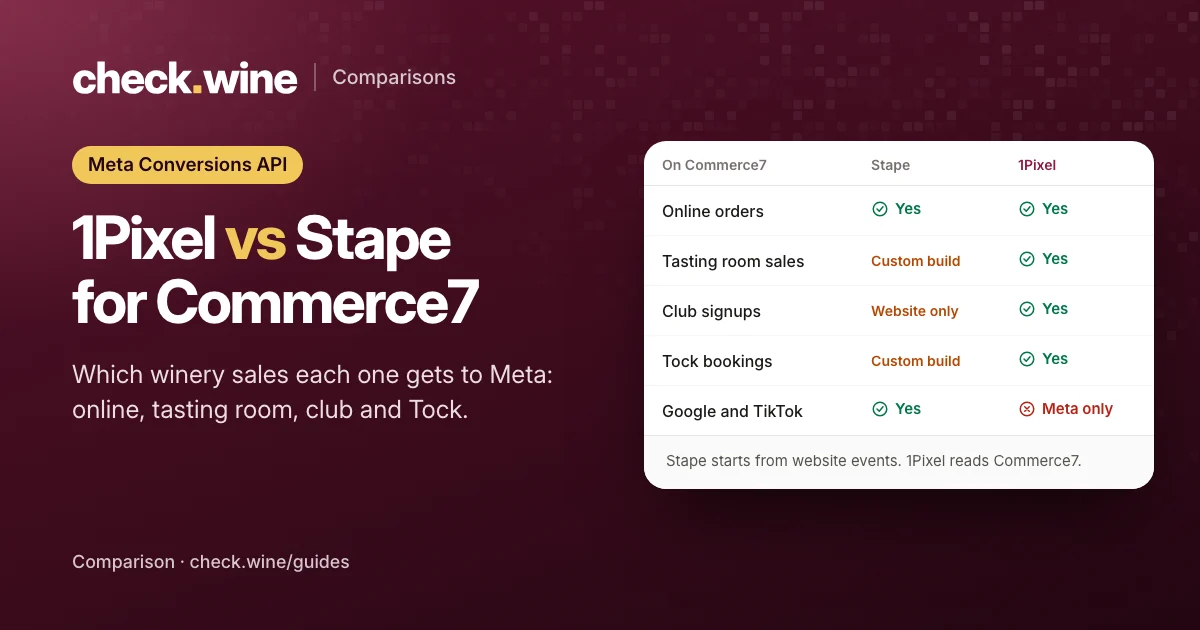
| On a Commerce7 site | Stape gateway or server-side Tag Manager | 1Pixel |
|---|---|---|
| Where events come from | Your website’s browser events | Commerce7 itself, plus an optional website script |
| Online orders | Yes, if your web tags send Purchase | Yes, every paid order |
| Tasting room and phone orders | Not from the website. Possible on server-side Tag Manager if a developer sends Commerce7’s order webhooks into the container | Yes, marked as in-store purchases |
| Club signups and cancellations | Only the signups made on the website, if tagged | Yes, with an optional average member value |
| Tock bookings | No, unless built | Yes, on Tock’s Full sync, as Lead or Purchase |
| Wine views and carts with the wine and price | Yes, once tags map Commerce7’s dataLayer events | Yes, with the website script |
| Club shipment orders kept out of sales | Your own rules | On by default |
| Other platforms | Google Analytics, Google Ads, TikTok and many more | Meta only |
| Setup | Tag Manager skills, ideally a tracking subdomain on your DNS | Install the app, paste the pixel ID and access token |
| Listed price | Gateway $8/mo per pixel; Tag Manager hosting free to 10,000 requests a month, then $17/mo to 500,000 | $29.99/mo |
On price alone, Stape is cheaper. The difference is coverage. A winery’s biggest sales channel is often the tasting room, followed by the club, and neither ever happens in a browser. A setup that starts from website events can’t report them unless someone builds that part.
The Commerce7 gap: sales that never touch the website
A Meta pixel, and anything that mirrors it, sees what happens on your website. On a Commerce7 winery that leaves out:
- Tasting room sales rung up on Commerce7 POS
- Phone and email orders entered by staff
- Club signups taken in person
- Tock bookings, which are made on Tock’s own pages
These still reach Meta’s Conversions API if something reads them from Commerce7. That is what Commerce7 apps such as 1Pixel are built for. Meta can then credit them to ads people saw before they visited, as explained in how to count tasting room sales in Meta ads.
The website side is easier than it sounds on Commerce7, whichever tool you pick. The Commerce7 storefront already pushes view_item, add_to_cart, begin_checkout and purchase events with the SKU, price and currency into the page’s dataLayer. A Tag Manager specialist can map those to Meta events and route them through Stape. The Commerce7 Meta pixel guide covers what each event should carry.
When Stape is the better choice
- You, or your agency, already run server-side Tag Manager and want Meta in the same place.
- You need Google Analytics, Google Ads or TikTok sent server-side as well, not only Meta.
- You sell mostly online and have few tasting room or club sales to report.
- You manage tracking for many brands on different platforms and want one tool for all of them.
When 1Pixel is the better choice
- Most of your sales happen in the tasting room, on the phone or through the club.
- You take bookings on Tock and want them in Meta with their value.
- Nobody on your team maintains Tag Manager, and you want a setup that keeps working without one.
- You want an Event Log that lists every order sent, with its Commerce7 order number and channel, to check Meta’s numbers against your own.
Running both without double counting
Plenty of wineries do both: Stape for Google Analytics and Google Ads, 1Pixel for Meta. The rule is that only one of them sends each Meta event, or that both use the same event ID so Meta keeps one copy.
- If 1Pixel sends Purchase, pause any Purchase tag for the same pixel in your web or server container. If you have to keep yours, give it the event ID
Purchase_followed by the Commerce7 order number, which is the ID 1Pixel uses. - If your containers already send wine views and carts to Meta, leave 1Pixel’s website script events off, or turn those tags off and let 1Pixel send them.
- A Stape Meta gateway on the same pixel as 1Pixel’s website script adds nothing: both send a server copy of the same browser events.
To see what reaches Meta now, open Events Manager, pick your pixel and look at each event’s connection method: browser, server, or both. A free check.wine check also flags pages that send the same Meta event twice.
Questions
Does Stape work with Commerce7?
Yes, through Google Tag Manager. Stape has no Commerce7 app, so a Tag Manager specialist maps the events Commerce7 pushes to the page into Meta tags and routes them through Stape’s server container or gateway.
Is 1Pixel a Stape alternative?
For a Commerce7 winery that needs Meta only, yes. It replaces the Meta part of a Stape setup and adds the tasting room, phone, club and Tock sales a website-based setup doesn’t see. It doesn’t send to Google Analytics, Google Ads or TikTok.
Which is cheaper?
Stape. Its Meta gateway is listed at $8 a month per pixel, paid yearly, and server-side Tag Manager hosting starts free. 1Pixel is $29.99 a month on every Commerce7 plan, with setup help included.
Can I use Stape and 1Pixel together?
Yes. A common split is Stape for Google and 1Pixel for Meta. Make sure only one of them sends each Meta event, or that both use the same event ID.
Does Meta’s free one-click Conversions API replace both?
Meta’s own setup copies the events your pixel already sends from the browser. It doesn’t add tasting room, phone or club sales, which only reach Meta from a connection that reads Commerce7.
Read next
All guides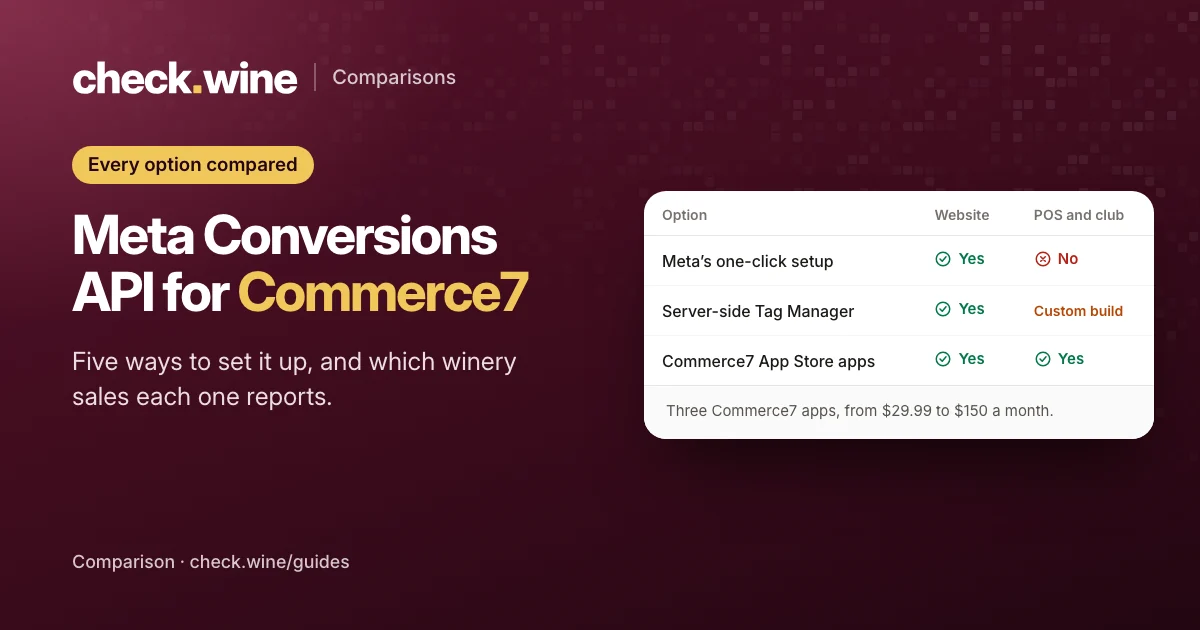 Comparison
Commerce7 Conversions API options
Five ways to send Commerce7 sales to Meta’s Conversions API: three App Store apps, Meta’s free setup and server-side Tag Manager. What each covers and costs.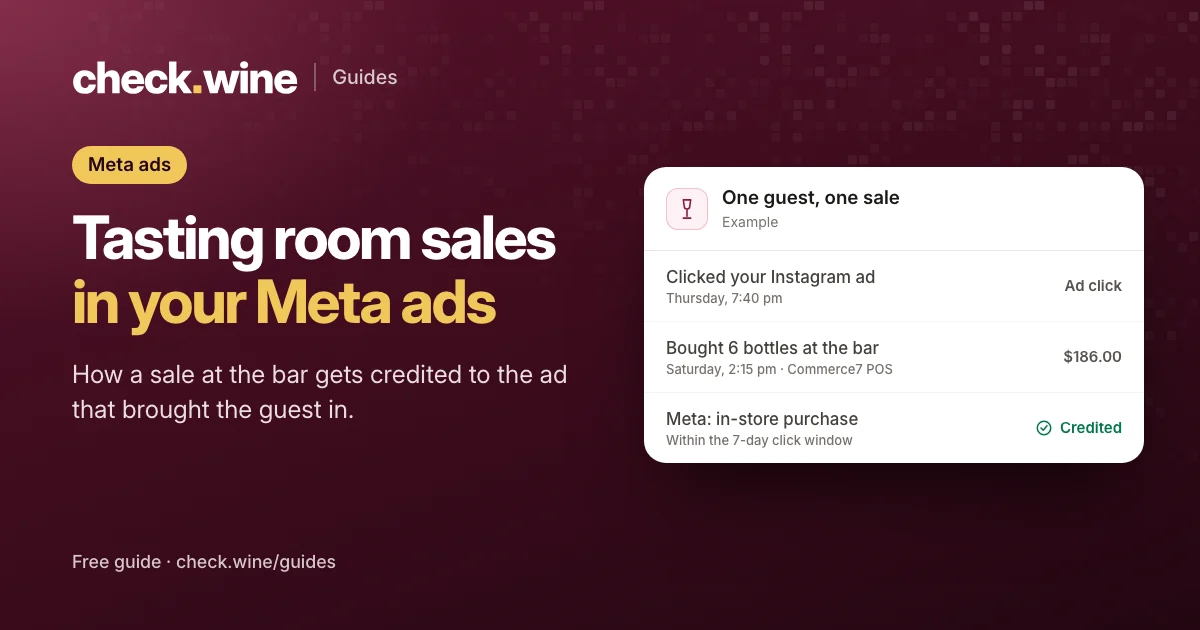 Guide
Tasting room sales in Meta ads
Meta can credit tasting room sales to your ads when each POS order reaches it as an in-store purchase. How it works on Commerce7, and how to report it.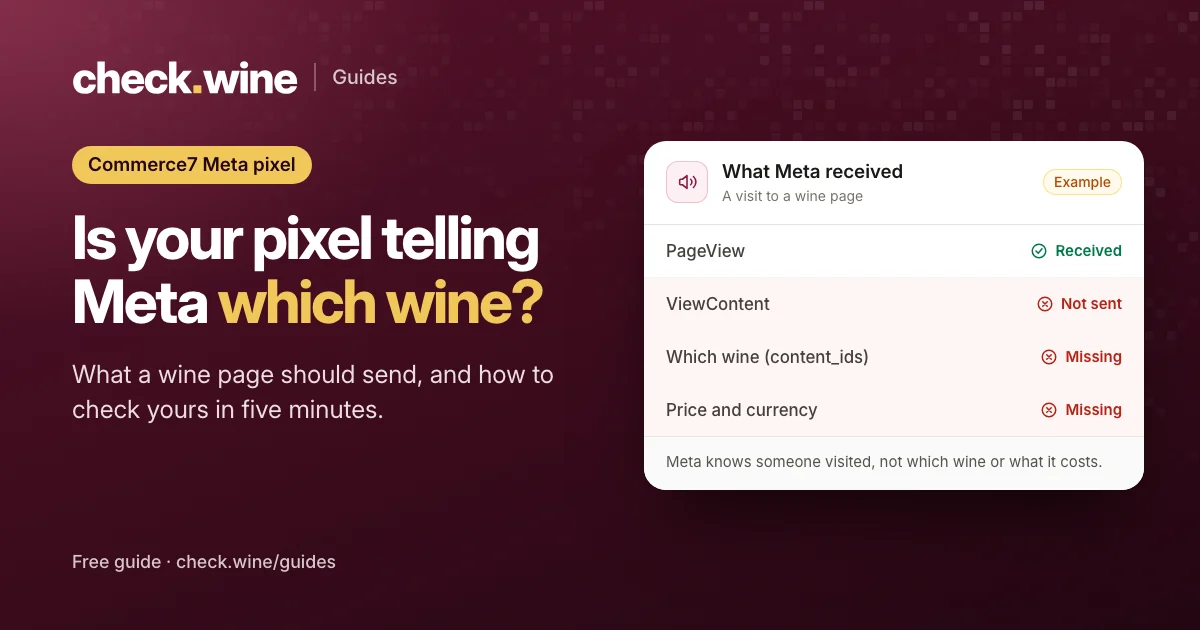 Guide